
Precision Medicine and the Power of Stem Cells: Highlights of the 2019 NYSCF Conference
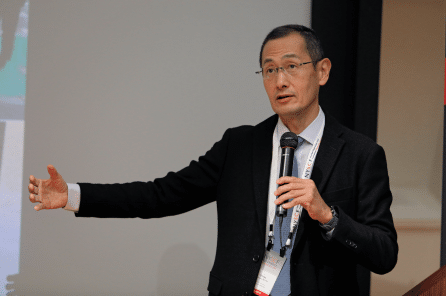
In 2006, Shinya Yamanaka, MD, PhD, made a discovery that revolutionized biomedical research and earned him a Nobel Prize....In 2006, Shinya Yamanaka, MD, PhD, made a discovery that revolutionized biomedical research and earned him a Nobel Prize. His lab found that stem cells, the body’s ‘building blocks,’ can be made from just a small sample of skin. These cells, called induced pluripotent stem cells (iPSCs), have changed the way we research disease, bringing us closer than ever to cures — Dr. Yamanaka’s (and NYSCF’s) ultimate goal.
“I am doing whatever it takes to bring this technology to patients,” remarked Dr. Yamanaka, in his keynote address at the 2019 NYSCF Conference. “When I was training as a young surgeon, my father passed away. I couldn’t do anything to help him, and that had a huge impact on me. I truly believe that it is science that will help patients suffering from intractable diseases.”
During the 2019 NYSCF Conference held at The Rockefeller University on October 22–23, over 500 researchers, students, and thought leaders shared their latest findings in translational stem cell research, highlighting how stem cells are being used to illuminate disease mechanisms, discover new therapies, and advance precision medicine.
A Vision for Precision Medicine
In his plenary lecture, biotech pioneer Lee Hood, MD, PhD, described his approach to modernizing medicine. Instead of only intervening once a disease has begun to manifest — which he calls ‘20th century medicine’ — Dr. Hood urged a more proactive and preventive approach.
“21st century medicine is really about studying wellness and the dynamics of disease, but most importantly, it’s about identifying the transitions from wellness to disease and reversing them at the earliest point,” explained Dr. Hood.
His team uses ‘deep phenotyping’ — that is, integrating vast amounts of clinical and molecular data on individuals — to identify these points of transition. This approach enables earlier diagnosis, identifies how diseases manifest differently across patients, and defines subgroups that would be more responsive to certain drugs.
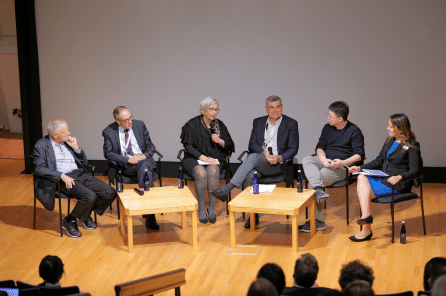
A panel discussion on precision medicine moderated by Raeka Aiyar, PhD, and featuring Dr. Hood, Susan Solomon, JD, Craig Thompson, MD, Antony Rosen, MBChB, MS, and Feng Zhang, PhD, further explored this topic and announced a new partnership between NYSCF, Johns Hopkins, and Bloomberg Philanthropies.
“Diseases are heterogenous, but within that heterogeneity are homogenous subgroups. Finding these homogenous subgroups at scale is a major opportunity,” explained Dr. Rosen. “With NYSCF, we are creating stem cells from these subgroups and making them available to investigators around the world to see if we can understand the driving mechanisms behind disease.”
“We are eager to move into 21st century medicine,” added Ms. Solomon. “This collaboration not only allows us to bring large-scale automation and AI to create precise biological models, but it allows us the information we need to discover what causes people to become unwell.”
Bringing Stem Cell Technology to Women’s Reproductive Cancers
Women’s reproductive cancers are a group of diseases that could greatly benefit from precision medicine. Most patients receive the same therapies, and the standard of care has not changed much in decades.
A panel discussion examined these issues and highlighted how they are being addressed by NYSCF’s Women’s Reproductive Cancers Initiative. The panel was chaired by Siddhartha Mukherjee, MD, DPhil, and featured Hans Clevers, MD, PhD, Laura Andres-Martin, PhD, Michael Birrer, MD, PhD, and Ursula Matulonis, MD. Dr. Andres-Martin leads the Initiative, and Drs. Mukherjee, Matulonis, and Birrer serve on the Initiative’s Scientific Advisory Board.
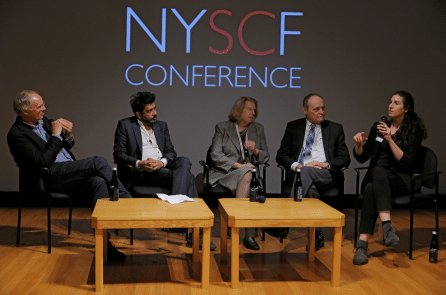
“The biology of the disease is so complex, and not much has been done to understand it, in part, because there hasn’t been much funding,” remarked Dr. Andres-Martin. “We realized this had to be addressed on a large scale, so we’ve brought together all these minds from around the world, and are using advanced technologies such as the organoids that Hans has developed to find new ways to help these patients.”
Organoids are 3D aggregates of human tissue made from stem cells that recapitulate how cells develop and interact, just as they would in the body. Dr. Clevers pioneered the development of organoids, which are now being used in labs around the world to study disease and development. At NYSCF, scientists are creating organoids from tumor samples, creating a living biobank that can be used to examine disease progression and test drugs.
“By definition, there are no animal models that are especially predictive. The only way to truly test is in a clinical trial, and going from an animal model to a trial is not very efficient. There’s a dire need for building new models like organoids,” said Dr. Clevers, who also delivered a keynote on how he is using organoids to understand the biology of cancer and screen drugs in his own lab.
The Future of Stem Cell Research
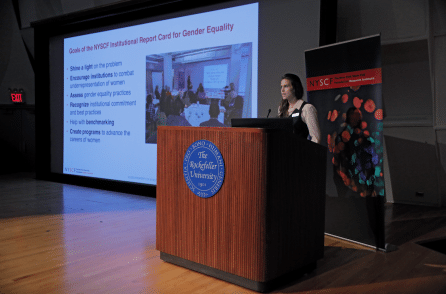
While progress is moving quickly, we cannot realize the full potential of stem cell research if we don’t have 100% of the available brainpower working toward cures. Gender equity in science continues to be a major issue— one that NYSCF is committed to addressing through its Initiative on Women in Science and Engineering (IWISE). Recently, members of IWISE took a closer look at the landscape of gender balance in science, and NYSCF Associate Vice President of External Programs Kristin Smith-Doody presented their findings.
“Our results across hundreds of institutions show that women continue to be systematically underrepresented in STEM leadership, making up under one quarter of full professors,” she explained. “We still have a lot of work to do, and it will take a concerted effort across many groups to reach equality.”
In addition to ensuring women have the resources they need to succeed in STEM, it is also important to foster the field’s young minds, seeding the pipeline for future discoveries. A poster session held on the first day of the conference featured 68 posters from talented young scientists around the world. This year’s winner was Jian Shu of the Broad Institute and Whitehead Institute, and runner-up was Fadi Jacob of Johns Hopkins University and the University of Pennsylvania.
Thank you to everyone who joined us for this year’s conference, and we hope to see you at next year’s meeting, which will take place October 20-21.
More Highlights
[metaslider id=12157]